Jason Louv - John Dee and the Empire of Angels; Enochian Magic and the Roots of the Modern World. Back in the 1980s, I and a few friends worked the Enochian System of John Dee and Edward Kelly (see my Tales of Magic, episodes 17-21, soon to appear on https://iotbis.wordpress.com/author/iotbis/). It is a system of staggering detail and complexity. Not to mention the distortions and baggage introduced by MacGregor Mathers, which have made it hard to know where to start. One of my co-workers once said: It would take a whole Enochian University working for a hundred years to work out what all the potentials of this system are. And that was just the technical, magical aspects; we had little idea then of exactly how important Dee's work was in creating the world we live in now. Louv's book makes a compelling case for the angels that Dee and Kelly channelled having a profound influence on both the British and American empires. And that's just for starters. This is a rich, ...
EPOCH - Esotericon and Portals of Chaos, by Peter J. Carroll and Matt Kaybrin, pub. Arcanorium College. http://www.esotericon.org/ This book has taken me some months to review. Partly because of its sheer size and scale, but also because it represents in some ways a summation of Peter Carroll's total contribution to magical practice and history. So it really made me think about what was important and what wasn't about this man's extraordinary work. I've known Pete Carroll since 1979, from meetings in the Sorcerer's Apprentice coffee mornings in Leeds. I was one of the founder members of the first IOT group in West Yorkshire, begun in 1980 and centred on the village of East Morton, where Ray Sherwin had a house, and where Pete Carroll lived for a while. So we go back a long way, and his work, particularly Liber Null , has often inspired me. Not only that, but nothing has yet come along to replace Chaos Magic as the forefront magical current; its history is the h...
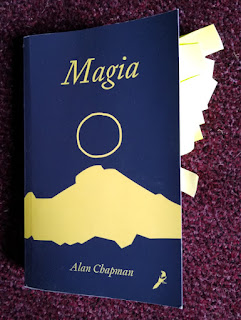
Available HERE . How do you write a review of a book which is about spiritual enlightenment, awakening, attainment, initiation or whatever you wish to call it? And not just about awakening, but an actual full scheme for attaining it? I shall of course outline the contents, but what about evaluating what is written here? I shall also try to give some of the flavour of Chapman’s teachings; but sadly for those who hate cliches, it really is the case that when the student is ready, the teacher appears. Ultimately, what draws a student to a teacher is itself part of the mystery. It seems to me that I can only evaluate what Alan Chapman is presenting as someone who has practiced the system; the only laboratory in which such writings can be tested is that of personal experience. So I shall have to tell my own Magia story. The book is a transcript of teachings delivered over six days at a retreat in Greece. It consists of those twelve sessions, with some unpacking, all rendered in blank v...


Comments
Post a Comment